
AAPB CE CO-SPONSORED EVENT: QEEG Live Didactic 5-Day Training with School of Neurotherapy
EVENT CONTACT:
REGISTRATION LINK:
https://www.schoolofneurotherapy.com/qeeg-qeegt
DATES:
June 22-26, 2026
TIMES:
8:00 am – 5:30 pm Pacific (.5 hour for lunch and two .25 breaks)
- 8 hours of instruction per day
- Morning Break – .25 break
- Lunch break – .5 hour
- Afternoon Break – .25 break
LOCATION:
- IN-PERSON PARTICIPATION: School of Neurotherapy, 1836 State Street, Santa Barbara, CA 93101
- VIRTUAL LIVE PARTICIPATION: by Video Conference
COURSE DESCRIPTION:
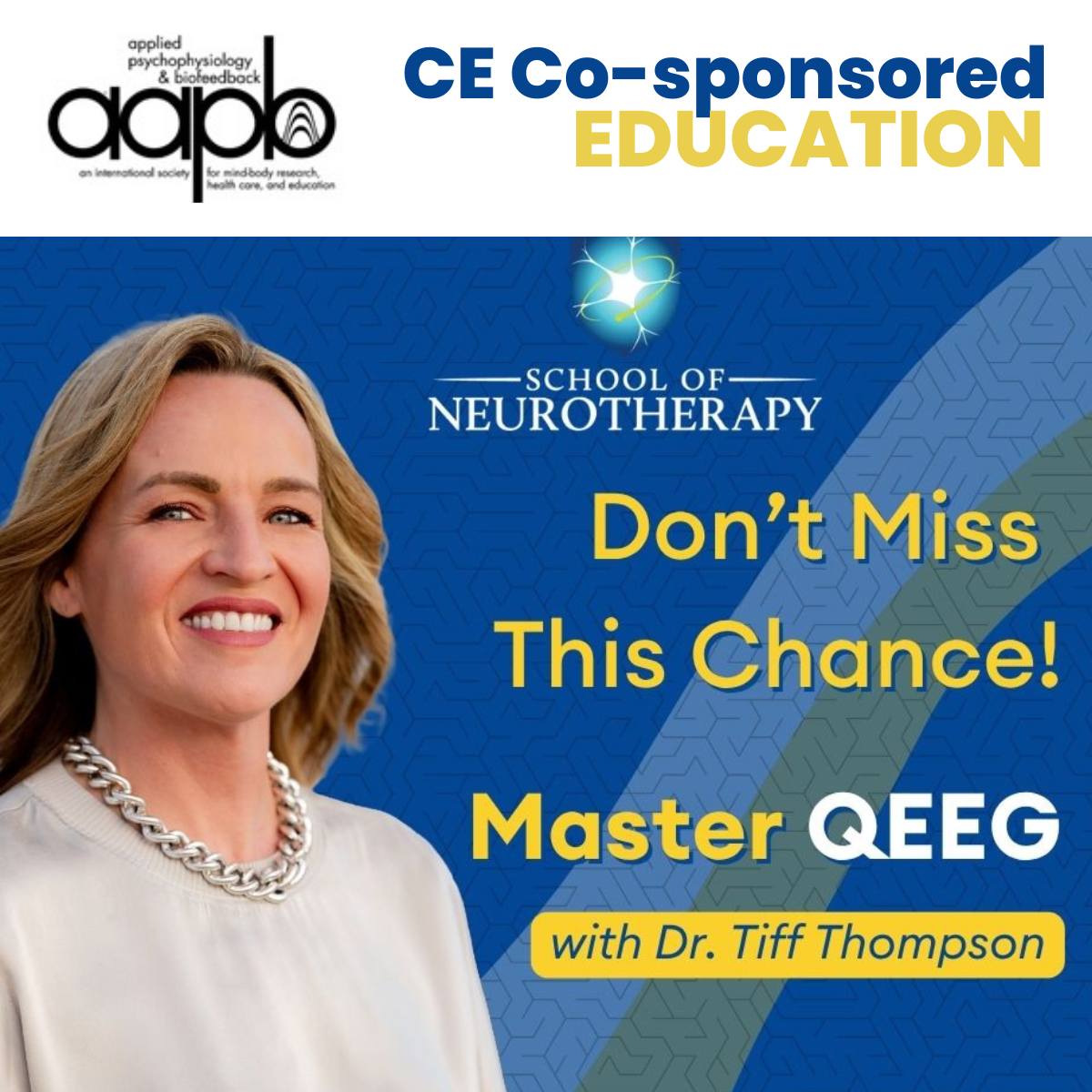
The Didactic, 40-hour, 5-Day QEEG Training is a live, in-person and online, live stream course. In-person and virtual training with Dr. Tiff Thompson, PhD, MFT, QEEG-D, R.EEG T, BCN
The Quantitative EEG Certification is a distinction that identifies someone who has competency in the reading of electroencephalographic data (EEG), as well as mastery of the quantification of that data (as seen in brain maps). This course meets the education requirement for final accreditation. Content and Discussion are guided by the most current blueprint of knowledge released by IQCB. Designed with attendees of all levels in mind, this course will teach multiple techniques and procedures through didactic lectures and hands-on training.
SCHEDULE OF EVENTS:
- Day 1: History of EEG / Neuroscience Overview – 8 hours
- Day 2: Technical/EEG/QEEG/ Psychopharmacology – 8 hours
- Day 3: Neuroscience/EEG/QEEG – 8 hours
- Day 4: EEG/QEEG/PSYCHOPHARMACOLOGY– 8 hours
- Day 5: QEEG/RESEARCH/ETHICS/ CLINICAL PRACTICE/FORENSIC – 8 hours
LEARNING OBJECTIVES:
- Describe basic knowledge of the history of quantitative electrophysiology
- Describe cortical and sub cortical structures macro and microanatomy
- Describe sensory pathways
- Describe the autonomic nervous system
- Describe major networks
- Explain behavioral correlates to brain regions and networks
- Describe electronics and instrumentation related to EEG and EPs
- Describe topographical representation of EEG
- Recognize electrodes and acquisition systems
- Analyze instrumentation (acquisition and review parameters/settings)
- Assess montages
- Explain electrical/clinical safety
- Explain fundamentals of functional neuroanatomy
- Explain network theories, neurochemistry, neuropharmacology and neuropathology
- Recognize basic knowledge of neurophysiology of EEG
- Apply editing and identifying artifacts
- Recognize normal waveform patterns
- Assess standards of EEG acquisition procedures including activation
- Recognize abnormal EEG waveforms and rhythms.
- Assess visual examination of EEG traces to identify time and location of artifact and pathology
- Describe the use of different EEG montages for wave form analysis
- Recognize the uniqueness of QEEG analysis from other neuro imaging techniques and conventional metrics derived from the EEG signal
- Recognize use of QEEG norms and methods used to derive QEEG norms
- Recognize the functional correlates of abnormal EEG changes
- Recognize the role of the qEEG metrics toward understanding and treating specific clinical presentations
- Recognize the relationship of the qEEG to other clinical examinations.
- Apply Brodmann Areas in terms of how areas were defined and most common functional attributes to these regions
- Recognize networks and connectivity and definitions of terms
- Recognize Current Source Density maps, metrics, and graphic methods of such (e.g., methods voxel representation of current course methods)
- Utilize reports based on QEEG metrics
- Utilize these reports in relation to clinical history, symptoms and other clinical assessments.
- Assess potential effects of prescribed and non-prescribed drugs on clinical presentation, potential effects of prescribed and non-prescribed drugs on EEG measure, potential effects of different drugs on learning tasks.
- Explain basic principles of half-lives and impact on interpreting QEEG
- Describe guidelines for the evaluation of drug effects on brain and behavior in individual patients
- Recognize experimental research designs and practice to facilitate research in the field of electrophysiology evaluate published data for purposes of adaptation to clinical practice.
- Summarize basic vs. clinical research
- Describe exploratory research vs. hypothesis testing and experimental design
- Describe basic statistics and differences between parametric versus nonparametric statistics
- Define types of validation and reliability and meta-analysis
- Describe reporting results and publication standards
- Recognize responsibilities and liability in provision of services.
- Summarize limits of interpreting QEEG regarding choice of reference databases and recognizing statistical probability versus clinical probability
- Recognize the difference in deposition as “fact/treating” witness vs “expert” witness
- Recognize Daubert vs Frye standards and their application to QEEG interpretation and use
- Describe emphasis of correlating QEEG with other clinical diagnostic evidence
- Recognize appropriateness of a QEEG referral and patient conditions related to QEEG evaluation
- Discuss history and prior clinical and laboratory reports
LEVEL: INTRODUCTORY
Content is designed for psychologists who may have little to no background in a specialized skill or content area. Through this level of programming, the learner can become acquainted with the theoretical underpinnings, principles, methods, and perspectives of a content area. An introductory level program also may serve as the foundation for subsequent intermediate and advanced learning. Introductory level programming may also be related to an emerging area of knowledge or practice. Although this content can be used as a foundation for more advanced learning, an introductory level program may simply focus on breadth, enrichment or general knowledge.
For those psychologists using the modality of biofeedback and interested in efficacy, science, and latest clinical applications. This conference (1) presents research relevant to psychological practice, education, and science; (2) it is our intention to host a continuing educational offering to help psychologists to keep up with the most current scientific evidence regarding assessment, intervention, and education; and (3) we believe that this program would allow psychologists, or other healthcare and mental healthcare practitioners, to increase competencies in order to improve services to patients/clients. This conference is IN NO WAY a substitute
CE CREDITS FOR MAXIMUM ATTENDANCE:
40.0 MAX CE Credits/8 per day
ABOUT THE PRESENTER: Dr. Tiff Thompson, CEO, School of Neurotherapy
Tiff Thompson, PhD, MFT, QEEG-D, R.EEG T, BCN, is a clinical neuroscientist, licensed therapist, educator, and technologist. She is the founder and owner of the Santa Barbara clinic, NeuroField Neurotherapy, where she offers quantitative electroencephalography (QEEG)-based functional brain consulting to clinicians. She has worked in neurology clinics, as well as clinical settings, and has taught kindergarten to university settings. Tiff has served as the Executive Director of the Western Association of Biofeedback and Neuroscience. She holds two master’s degrees, one in Depth Counseling Psychology and another in Rhetoric. She has a PhD in Psychology; her dissertation was on the intersection of psychodynamic psychology model of the psyche and electroencephalography (EEG). She is board certified in neurotherapy and a licensed diplomate of quantitative EEG.
She teaches neuromodulation and neurofeedback courses nationally and internationally for NeuroField, Inc. with her husband, Nicholas Dogris. She also organizes and hosts a yearly conference in Santa Barbara for neurotherapy practitioners. She is the creator of an online educational platform: The School of Neurotherapy, which runs three separate curricula: Quantitative EEG Didactic training, Board Certification in Neurotherapy Didactic training, and Neuromodulation education. Tiff regularly delivers public lectures on all things concerning neurodiagnostics and the clinical application of neurostimulation.
Financial Interest Disclosure:
Dr. Thompson owns The School of Neurotherapy. The School of Neurotherapy, hosts many related courses. The research findings presented herein are not related to any products or services currently provided by The School of Neurotherapy.
Utility/Validity/Risks:
Materials that are included in this course may include interventions and modalities that are beyond the authorized practice of mental health professionals. As a licensed professional, you are responsible for reviewing the scope of practice, including activities that are defined in law as beyond the boundaries of practice in accordance with and in compliance with your profession’s standards.
There are no risks, severe or otherwise, with the content of the education afforded in this training. Outcomes are still subject to evidence from large, randomized control clinical trials.
CONTINUING EDUCATION STATEMENTS
 Psychologists: The Association for Applied Psychophysiology and Biofeedback is approved by the American Psychological Association to sponsor continuing education for psychologists. The Association for Applied Psychophysiology and Biofeedback maintains responsibility for the program and its content.
There is no known commercial support for this program. This virtual workshop offers a MAXIMUM of 40.0 CE credits for maximum participation.
BCIA Recertification: Hour-for-hour attendance may be used to fulfill the continuing education requirements for recertification with certificate of attendance.
Psychologists (APA) Coverage & Reciprocity
The following state boards accept courses from APA providers for Counselors: AK, AL, AR, AZ, CA, CO, CT, DC, DE, FL, GA, HI, IA, ID, IL, IN, KS, KY, MD, ME, MO, NC, ND, NH, NE, NJ, NM, NV, OK*, OR, PA, RI, SC, SD, TN, TX, UT, VA, WI, WY
MI: No CE requirements
The following state boards accept courses from APA providers for MFTs: AK, AR, AZ, CA, CO, CT, DE, FL, GA, IA, ID, IN, KS, MD, ME, MO, NE, NC, NH, NJ, NM, NV, OK*, OR, PA, RI, SC, SD, TN, TX, UT, VA, WA, WI, WY
The following state boards accept courses from APA providers for Addictions Professionals: AK, AR, CO, CT, DC, DE, GA, IA, IN, KS, LA, MD, MO, MT, NC, ND, NE, NJ, NM, NY (outstate held), OK*, OR, SC, UT, WA, WI, WY
* OK accepts APA credit for live, in-person activities. For all ethics and/or online courses, an application is required.
MA / MFTs: Participants can self-submit courses not approved by the MAMFT board for review.
The following state boards accept courses from APA providers for Social Workers: AK, AR, AZ, CA, CO, DE, FL, GA, ID, IN, KY, ME, MN, MO, NE, NH, NM, OR, PA, VT, WI, WY
IMPORTANT NOTICE: Those who attend this event in full and complete the appropriate evaluation form will receive CE credits. Those arriving more than 15 minutes after the start time or leaving before a given activity is completed will not receive CE credit.
Refund/Cancellation Policy: You may cancel your registration up to 30 days prior to the event. Refunds or exchanges are granted only 30 days prior to the event or earlier. Please email us to request your cancellation at [email protected]. Fees cannot be refunded for registrations cancelled after the period of 30 days prior.
Registration Policy: Registrations first come, first served. Once payment is received your seat in the training will be confirmed.
Grievance Policy: The Association of Applied Psychophysiology and Biofeedback (AAPB) is fully committed to conducting all activities in strict conformance with the American Psychological Association's Ethical Principles of Psychologists. AAPB will comply with all legal and ethical responsibilities to be non-discriminatory in promotional activities, program content and in the treatment of program participants. The monitoring and assessment of compliance with these standards will be the responsibility of the Education Chair in consultation with the members of the continuing education committee, the AAPB Ethics Chairperson, Continuing Education (CE) Committee Chairperson, Program Planning Committee Chairperson, and/or the Conference Chairperson. While AAPB goes to great lengths to assure fair treatment for all participants and attempts to anticipate problems, there will be occasional issues which come to the attention of the convention staff which require intervention and/or action on the part of the convention staff or an officer of AAPB. This procedural description serves as a guideline for handling such grievances. 1. When a participant, either orally or in written format, files a grievance and expects action on the complaint, the following actions will be taken. If the person toward whom the grievance is directed is also the instructor or a chair of any of the above-mentioned committees, the AAPB Board of Directors will appoint a Board representative to oversee the resolution of any of the participant complaints, in an effort to avoid any and all conflicts of interest. If the grievance concerns a speaker, the content presented by the speaker, or the style of presentation, the individual filing the grievance will be asked to put his/her comments in written format. The CE Chair will then pass on the comments to the speaker, assuring the confidentiality of the grieved individual. 2. If the grievance concerns a workshop offering, its content, level of presentation, or the facilities in which the workshop was offered, the convention chair will mediate and will be the final arbitrator. If the participant requests action, the convention chair will: a) attempt to move the participant to another workshop or b) provide a credit for a subsequent year's workshop or c) provide a partial or full refund of the workshop fee. Actions 2b and 2c will require a written note, documenting the grievance, for record keeping purposes. The note need not be signed by the grieved individual. 3. If the grievance concerns an AAPB CE program, in a specific regard, the CE Chair will attempt to arbitrate.
Contact name(s)*: Leslie Shivers, AAPB Executive Director
Email: [email protected]
Telephone: 800-477-8892 or +1 303-422-8436
Address: PO Box 461797, Aurora, CO 80046-1797
