
AAPB Co-sponsored Event: BCIA-Aligned HRV Biofeedback Training Led by Dr. Inna Khazan
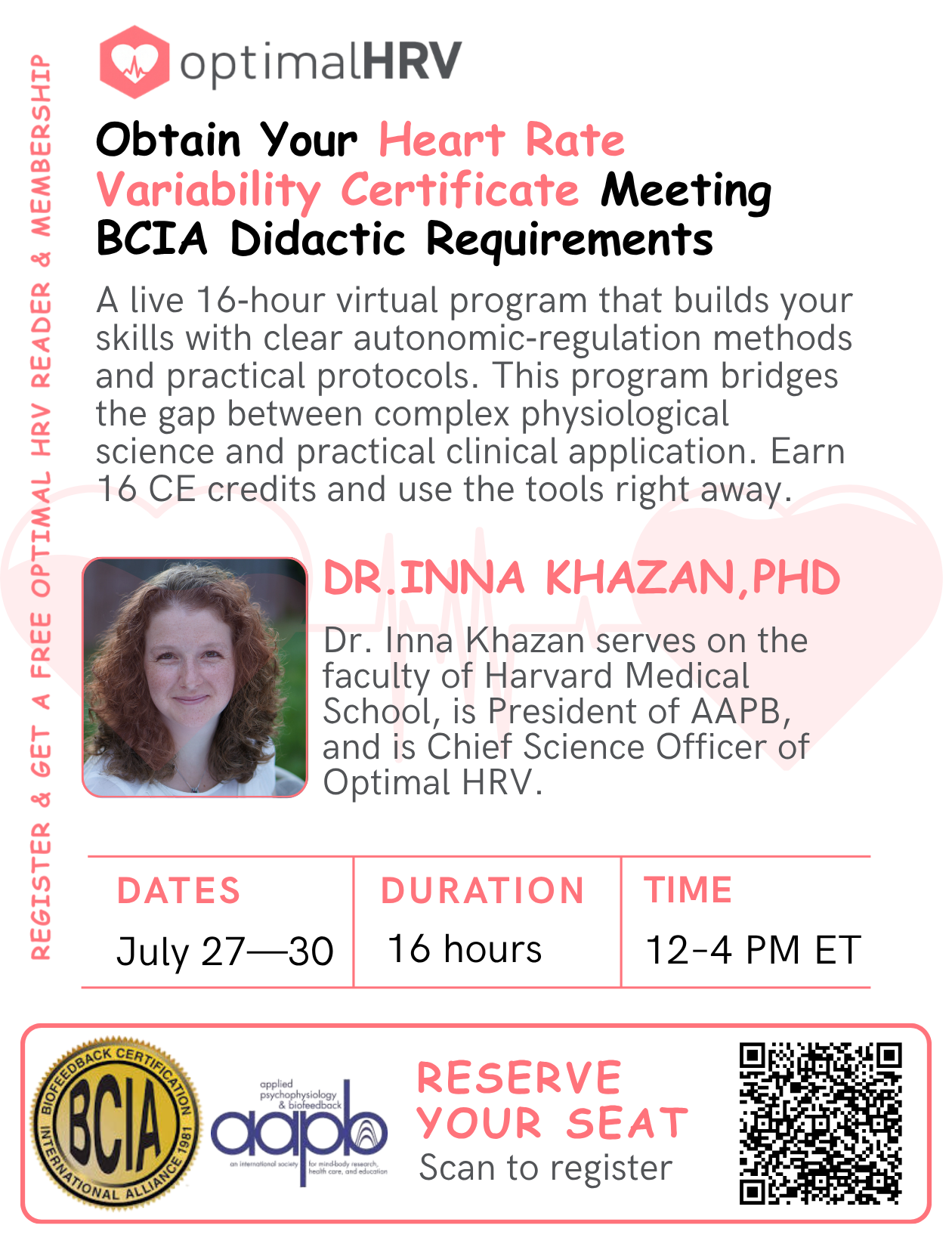
AAPB Co-sponsored Event
CLICK HERE TO REGISTER: https://www.optimalhrv.com/event-details-registration/bcia-aligned-hrv-biofeedback-training-led-by-dr-inna-khazan
DATES: July 27-30, 2026 (4-day event)
TIME:
- 12 PM to 4 PM EDT
- 11 AM to 3 PM CDT
- 10 AM to 2 PM MDT
- 9 AM to 1 pm PDT
LOCATION: Virtual (Zoom)
Description: Master the science of Heart Rate Variability in this professional training program led by Dr. Inna Khazan, co-sponsored by AAPB. This course fulfills the official BCIA didactic requirement, the essential first step toward BCIA HRV certification. This program bridges the gap between complex physiological science and practical clinical application. We have distilled years of Harvard-level clinical expertise into a 16-hour curriculum that integrates immediately into your practice. You will walk away with 16 CE credits and the BCIA-recognized didactic foundation needed to advance your career as a specialist in the field. Heart rate variability biofeedback is one of the fastest-growing evidence-based interventions across mental health, medicine, performance coaching, and stress resilience training. It provides an objective, real-time physiological signal that responds to breath, thought, and regulation. By training clients to modulate their autonomic nervous system, you provide them with a measurable tool for self-regulation that is effective from the very first session. The research base is robust, the clinical applications are diverse, and the demand for board-aligned practitioners is accelerating. What stops most professionals is not motivation — it is the assumption that biofeedback requires costly hardware, complex setup, or years of specialist training. That assumption is wrong. With the right knowledge and accessible platforms like Optimal HRV, you can implement HRV biofeedback in your existing practice immediately, using affordable sensors that make professional-grade tracking accessible to every client. Heart rate variability refers to the natural beat-to-beat fluctuation in heart rate regulated by the autonomic nervous system. Higher, more flexible HRV is consistently associated with stronger stress resilience, better emotional regulation, improved cardiovascular health, and higher cognitive and athletic performance. Lower HRV correlates with anxiety, depression, chronic pain, burnout, and cardiovascular disease risk. HRV biofeedback trains clients to breathe at their individual resonant frequency — typically between 3.5 and 7 breaths per minute — which produces a measurable increase in HRV and strengthens the body's self-regulation systems, resulting in lasting improvements in the nervous system's response to stress, emotion, and performance demands.
This 16-hour virtual training gives you the standardized, evidence-based foundation to implement HRV biofeedback confidently — built on the full Biofeedback Certification International Alliance (BCIA) HRV Biofeedback Blueprint of Knowledge, taught by a BCIA-authorized trainer, Dr. Inna Khazan, and co-sponsored by the Association for Applied Psychophysiology and Biofeedback (AAPB). These organizations represent the industry gold standard, ensuring your training meets the highest international requirements for clinical excellence.
Who this training is intended for:
- A mental health professional — psychologist, therapist, counselor, social worker, or marriage and family therapist — looking to integrate HRV biofeedback and longitudinal tracking to strengthen clinical outcomes and give clients an objective sense of their own progress.
- A medical or health professional — physician, nurse practitioner, or allied health professional — interested in utilizing HRV biofeedback as a powerful tool to improve the health of the autonomic nervous system. This training focuses on combining clinical protocols with remote tracking to manage stress, cardiac health, chronic illness, and pain by restoring autonomic balance and resilience.
- A performance professional — sport psychologist, mental performance consultant, athletic trainer, or strength and conditioning specialist — wanting to use biofeedback training and recovery tracking as objective, measurable methods for building resilience and optimizing performance under pressure.
- A health or organizational coach — health coach, corporate wellness consultant, or organizational consultant — who wants to ground their coaching work in validated physiological science and utilize HRV biofeedback to deliver measurable outcomes to clients and employers.
- A breathwork practitioner or integrative wellness provider who wants to bridge their existing breathwork expertise with clinical HRV science, structured biofeedback protocols, and data-driven tracking.
- Any professional pursuing the BCIA HRV Certificate of Completion who needs a didactic program that fully meets the official BCIA Blueprint requirements, taught by a trainer officially listed and verified by BCIA.
- Target Audience: This training is designed for psychologists, counselors, marriage and family therapists, social workers, psychiatrists, physicians, nurses, occupational therapists, physical therapists, speech-language pathologists, behavioral medicine clinicians, biofeedback practitioners, neurofeedback providers, integrative and behavioral health professionals, and qualified performance professionals such as athletic trainers, strength and conditioning specialists, mental performance consultants, and wellness coaches working within their scope of practice.
What You Will Get:
This program is structured around the official BCIA HRV Blueprint of Knowledge — the authoritative curriculum framework established by the Biofeedback Certification International Alliance for HRV biofeedback didactic training. It is co-sponsored by AAPB (the Association for Applied Psychophysiology and Biofeedback), the leading professional organization in the field. Upon completing this course with full attendance, you receive:
- Certificate of Completion bearing the official BCIA stamp
- 16 CE credits (live/full attendance required — see CE details below)
- Fulfillment of the BCIA HRV Didactic Education Requirement – This fulfills the 16-hour "Blueprint of Knowledge" training required by BCIA. It is the mandatory first step toward earning your full BCIA HRV Certification (which requires a separate application, fees, and passing the BCIA proctored exam).
- Practical skills you can use immediately — not conceptual understanding alone, but structured protocols, session frameworks, and clinical strategies
This training is a professionally accredited, Blueprint-aligned, BCIA-authorized training designed to meet the standards set by one of the most respected credentialing bodies in the field.
All 16 Hours Are Mapped To The BCIA Blueprint:
Every session is structured around the official BCIA HRV Blueprint of Knowledge.
1. HRV Anatomy & Physiology — 3 hours
A solid foundation in the physiology underlying HRV biofeedback is essential for both clinical credibility and effective teaching. This module covers:
Cardiac anatomy and physiology — how the ECG is generated, the role of the sinoatrial node, and the mechanisms of cardiac conduction. Sympathetic and parasympathetic influences on heart rate — how the autonomic nervous system drives beat-to-beat variability and why this matters clinically. The heart-brain connection — bidirectional communication between cardiac and central neural systems.
Respiratory anatomy and physiology — the functions of breathing, the respiratory cycle in detail, the role of the diaphragm and accessory muscles, and the Bohr effect (how CO2 concentration affects oxygen delivery and pH balance). Functional versus dysfunctional breathing patterns — identification, clinical significance, and intervention.
Autonomic nervous system anatomy — the three-branch model (sympathetic, parasympathetic, and enteric), polyvagal considerations, and the critical role of the vagus nerve in HRV regulation and self-regulation capacity.
2. Heart Rate Variability — 2 hours
What HRV actually means physiologically and clinically. The primary and secondary sources of HRV. The full range of factors that influence HRV includes age, fitness level, and sleep, as well as medication, posture, and psychological state. Correlates of low HRV across clinical and subclinical populations. The well-established, research-supported benefits of increasing HRV through biofeedback training.
3. HRV Instrumentation — 3 hours
Practical mastery of the instruments used in HRV biofeedback requires both conceptual knowledge and hands-on understanding of signal quality, placement, and artifact identification.
Blood volume pulse (BVP): Source, PPG sensor technology, signal characteristics, finger and earlobe placement options, tracking test procedures, and common artifacts.
Electrocardiogram (ECG/EKG): Source, electrode types, signal characteristics, standard placement protocols, tracking test procedures, and artifact identification.
Respirometer: Source, signal characteristics, chest and abdomen placement, tracking test procedures, and common sources of signal degradation.
Accessory SEMG: Source, signal characteristics, placement for respiratory monitoring and postural assessment, tracking test procedures, and artifacts.
Artifacting strategies: How to identify, manage, and document signal artifacts systematically to ensure clean, interpretable data.
4. HRV Measurements — 2 hours
Time domain measurements — SDNN, RMSSD, pNN50, and their clinical meaning, mathematical properties, and population-based correlates. Frequency domain measurements — VLF, LF, HF, and LF/HF ratio — their meaning, properties, controversy, and clinical utility. Brief versus 24-hour monitoring protocols — when each is appropriate and what each tells you. How to interpret HRV measurements accurately and communicate findings to clients in meaningful, non-technical terms.
5. HRV Biofeedback Strategies — 4 hours
The clinical core of the training. This module is where physiological knowledge becomes clinical skill:
- How to explain HRV biofeedback to a client — in language that builds understanding, reduces anxiety, and increases engagement. How to assess breathing — identifying breathing patterns, rate, amplitude, upper chest versus diaphragmatic dominance, and signs of dysfunctional breathing. How to measure resonance frequency — the step-by-step protocol for identifying each individual client's resonance frequency.
- How to teach resonance frequency breathing — pacing strategies, common client challenges, and how to troubleshoot. How to structure a complete HRV biofeedback training session — intake, baseline assessment, training protocol, feedback review, and close. How to augment training with emotional regulation strategies — integrating mindfulness, acceptance-based approaches, and cognitive reframing into the biofeedback session.
- HRV biofeedback side effects and contraindications — what to watch for, how to respond, and which client presentations require additional caution. Practice assignments to promote generalization — how to design between-session practice that builds on in-session gains and transfers skill to daily life.
6. HRV Applications — 2 hours
Clinical applications — anxiety disorders, depression, PTSD, chronic pain, hypertension, cardiac rehabilitation, insomnia, and the role of HRV biofeedback in integrated behavioral medicine. Optimal performance applications — athletic performance, recovery optimization, military and first responder resilience, executive performance under stress, and corporate wellness programming.
FAQs
Q: Do I need a background in biofeedback to attend? No prior biofeedback experience is required. This training is designed to build genuine competence from the ground up and is suitable for professionals with and without prior exposure to biofeedback. Participants are expected to bring professional clinical or coaching experience, but not prior biofeedback training.
Q: Is Dr. Khazan officially authorized by BCIA to provide this training?Yes. Dr. Khazan is officially listed as an authorized HRV didactic training provider by the Biofeedback Certification International Alliance. You can verify this directly at: https://bcia.memberclicks.net/assets/HRVCommonDocs/HRV%20Didactic%20Training.pdf. Only programs taught by BCIA-authorized trainers qualify for the BCIA HRV Certificate of Completion. This training qualifies.
Q: Does completing this course make me BCIA certified? While this course (led by Dr. Inna Khazan) is BCIA-aligned and covers the 16-hour Blueprint of Knowledge required by the Biofeedback Certification International Alliance (BCIA), it is only the first step. To become fully BCIA Certified in HRV, an applicant must also:
- Fulfill the Ethics Requirement: Complete 3 hours of BCIA-approved ethics/professional standards coursework.
- Apply to BCIA: Submit a formal application and pay the required fees.
- Pass the Exam: Successfully pass the proctored, 50-item multiple-choice HRV exam administered by BCIA.
- Clinical Background (for Full Certification): For the Clinical HRV Certification, you must also hold an appropriate degree in a health care field. Those without a clinical background receive the HRV Certificate of Completion rather than the professional 'Board Certified' designation.
Q: Can I use these CE credits toward my license renewal? The 16 credits are provided by AAPB, which is approved by APA to sponsor CE for psychologists. Acceptance of APA-approved CE for other license types (e.g., LCSW, MFT, LPC) varies by state licensing board. Please see the full CE statement below, which lists currently accepted state boards, and confirm with your own board before enrolling.
Q: Will these credits count toward my NBCC requirements? AAPB is not an NBCC-approved provider. Participants seeking NBCC credit must apply independently. Approval is not guaranteed. See the CE statement for full details.
Q: What platform does the training use? The training is delivered virtually via Zoom.
Q: What equipment do I need? None. You do not need any specialized sensors or hardware to participate in this training. We have designed the course so that you can fully engage with the curriculum without an upfront equipment investment. To help you apply what you've learned afterward, we are including a free lifetime membership (a $149.99 value) with your registration, allowing you to practice the concepts at your own pace once the training concludes.
Co-sponsored by AAPB and aligned with the BCIA HRV Biofeedback Blueprint of Knowledge
CE Credits: CE information to be provided with registration details. This training is designed to support the didactic education component of the BCIA HRV Certificate pathway.
Learning Objectives:
1. Explain HRV biofeedback clearly and confidently to any client, colleague, or referring provider — using language appropriate for each audience
2. Set up and interpret HRV biofeedback instrumentation accurately, including BVP, ECG, respirometry, and accessory SEMG
3. Assess client breathing patterns and distinguish functional from dysfunctional breathing with clinical precision
4. Measure individual resonance frequency using the established step-by-step protocol
5. Teach resonance frequency breathing effectively, troubleshoot common challenges, and adapt your approach for different clients
6. Structure a complete HRV biofeedback training session from intake through practice assignment design
7. Interpret both time domain and frequency domain HRV measurements in a clinical context — and explain them to clients
8. Integrate emotional regulation strategies into biofeedback sessions in a coherent, evidence-informed way
9. Navigate contraindications, side effects, and ethical considerations with confidence
10. Apply HRV biofeedback protocols across clinical populations and performance settings
11. Design home practice assignments that promote generalization and sustain the gains made in session
12. Apply setting up and verifying HRV instrumentation
13. Interpret core HRV measures to guide training decisions
14. Deliver a complete HRV biofeedback session with appropriate documentation, ethics, and scope-of-practice considerations
15. Apply templated session plans and take-home practice protocols for immediate clinical deployment.
Level: Introductory
Content is designed for psychologists who may have little to no background in a specialized skill or content area. Through this level of programming, the learner can become acquainted with the theoretical underpinnings, principles, methods, and perspectives of a content area. An introductory level program also may serve as the foundation for subsequent intermediate and advanced learning. Introductory level programming may also be related to an emerging area of knowledge or practice. Although this content can be used as a foundation for more advanced learning, an introductory level program may simply focus on breadth, enrichment or general knowledge.
*The primary goal of this particular program is to broaden the clinical, consultative, and research knowledge bases of attendees and was deemed intermediate, by the definition above.
# of CE credits allowable for maximum attendance:
Day 1 – Anatomy & Physiology and HRV (4 CE Credits)
Day 2 – HRV and Instrumentation (4 CE Credits)
Day 3 – Measurements and HRV Biofeedback Strategies (4 CE Credits)
Day 4 – HRV Biofeedback Strategies and Applications (4 CE Credits)
MAX EVENT: 16.0 CE Credits
About the Presenter:
Inna Khazan, PhD, BCB
Dr. Inna Khazan, PhD, BCB, is a Chief Science Officer of Optimal HRV and a faculty member of Harvard Medical School, BCIA Board Certified Biofeedback Provider (BCB), BCIA-Authorized HRV Didactic Trainer — Founder and Director of Boston Center for Health Psychology, Biofeedback Author, "The Clinical Handbook of Biofeedback " (Wiley-Blackwell), and "Biofeedback and Mindfulness in Everyday Life" (Norton). Dr. Khazan is one of the most widely respected educators, clinicians, and pioneers in applied biofeedback and HRV in North America. A licensed clinical psychologist specializing in biofeedback and mindfulness-based approaches to optimizing health and performance, she has spent more than 20 years helping people overcome a wide range of personal and professional challenges — from anxiety, depression, and chronic pain to high-performance stress management — and has trained hundreds of professionals across medicine, psychology, coaching, and research. She is a Faculty Member at Harvard Medical School, where she teaches and supervises clinical trainees, and the founder of the Boston Center for Health Psychology and Biofeedback, one of the most established clinical biofeedback practices in the United States. As Chief Science Officer at Optimal HRV, her work continuously bridges rigorous research and real-world clinical application. Recognized as a pioneer in mindfulness-based biofeedback, she is a popular and sought-after speaker at national and international biofeedback and mindfulness conferences. Crucially for professionals seeking BCIA credentials, Dr. Khazan is an officially authorized HRV didactic trainer listed by BCIA. Not all HRV courses qualify for BCIA didactic credit — this one does, because it is taught by a BCIA-accredited instructor. You can verify her status and confirm this training meets the BCIA didactic requirement directly on the BCIA website. Her teaching is known for a quality that is genuinely rare in professional training — she makes demanding physiology accessible without ever dumbing it down. Participants consistently report leaving not just with knowledge, but with a working clinical protocol they can implement immediately.
Disclosures: There is known commercial support for this program. Our presenters have financial interests to disclose. Dr. Khazan (Chief Science Officer) is affiliated with Optimal HRV. Optimal HRV produces in-app biofeedback training modules. The presenter may benefit financially from the research findings on in-app biofeedback training modules presented herein. This training will be presented free of commercial bias.
Utility/Validity/Risks:
All interventions discussed in this training are empirically supported. Minimal risks, such as lightheadedness during breathing, are associated with HRV-based interventions and will be addressed during the training.
Materials that are included in this course may include interventions and modalities that are beyond the authorized practice of mental health professionals. As a licensed professional, you are responsible for reviewing the scope of practice, including activities that are defined in law as beyond the boundaries of practice in accordance with and in compliance with your profession’s standards.
There are no risks, severe or otherwise, with the content of the education afforded in this training. Outcomes are still subject to evidence from large, randomized control clinical trials.
CONTINUING EDUCATION STATEMENTS
 Psychologists: The Association for Applied Psychophysiology and Biofeedback is approved by the American Psychological Association to sponsor continuing education for psychologists. The Association for Applied Psychophysiology and Biofeedback maintains responsibility for the program and its content.
This virtual workshop offers a MAXIMUM of 16.0 CE credits for maximum participation.
 BCIA Recertification: Hour-for-hour attendance may be used to fulfill the continuing education requirements for recertification, with certificate(s) of attendance. The Biofeedback Certification International Alliance (BCIA) was created with the primary mission to certify individuals who meet education and training standards in biofeedback and progressively recertify those who advance their knowledge through continuing education.
 IQCB will accept 16 credits for recertification for full attendance as non-qEEG-specific credits.
Psychologists (APA) Coverage & Reciprocity
The following state boards accept courses from APA providers for Counselors: AK, AL, AR, AZ, CA, CO, CT, DC, DE, FL, GA, HI, IA, ID, IL, IN, KS, KY, MD, ME, MO, NC, ND, NH, NE, NJ, NM, NV, OK*, OR, PA, RI, SC, SD, TN, TX, UT, VA, WI, WYMI: No CE requirements. The following state boards accept courses from APA providers for MFTs: AK, AR, AZ, CA, CO, CT, DE, FL, GA, IA, ID, IN, KS, MD, ME, MO, NE, NC, NH, NJ, NM, NV, OK*, OR, PA, RI, SC, SD, TN, TX, UT, VA, WA, WI, WYThe following state boards accept courses from APA providers for Addictions Professionals: AK, AR, CO, CT, DC, DE, GA, IA, IN, KS, LA, MD, MO, MT, NC, ND, NE, NJ, NM, NY (outstate held), OK*, OR, SC, UT, WA, WI, WY * OK accepts APA credit for live, in-person activities. For all ethics and/or online courses, an application is required.MA / MFTs: Participants can self-submit courses not approved by the MAMFT board for review.The following state boards accept courses from APA providers for Social Workers: AK, AR, AZ, CA, CO, DE, FL, GA, ID, IN, KY, ME, MN, MO, NE, NH, NM, OR, PA, VT, WI, WY
IMPORTANT NOTICE: Those who attend this event in full and complete the appropriate evaluation form will receive CE credits. Those arriving more than 15 minutes after the start time or leaving before a given activity is completed will not receive CE credit.
Cancellation Policy: Please contact OptimalHRV at [email protected] to request a refund or cancellation. Cancellations received at least 2 weeks prior to the training will be refunded minus a $10 processing fee. Cancellations within 2 weeks of the event will not be refunded, but may be credited toward future events. Fees cannot be refunded for registrations canceled after the presentation begins.
Grievance Policy: The Association of Applied Psychophysiology and Biofeedback (AAPB) is fully committed to conducting all activities in strict conformance with the American Psychological Association's Ethical Principles of Psychologists. AAPB will comply with all legal and ethical responsibilities to be non-discriminatory in promotional activities, program content and in the treatment of program participants. The monitoring and assessment of compliance with these standards will be the responsibility of the Education Chair in consultation with the members of the continuing education committee, the AAPB Ethics Chairperson, Continuing Education (CE) Committee Chairperson, Program Planning Committee Chairperson, and/or the Conference Chairperson. While AAPB goes to great lengths to assure fair treatment for all participants and attempts to anticipate problems, there will be occasional issues which come to the attention of the convention staff which require intervention and/or action on the part of the convention staff or an officer of AAPB. This procedural description serves as a guideline for handling such grievances. 1. When a participant, either orally or in written format, files a grievance and expects action on the complaint, the following actions will be taken. If the person toward whom the grievance is directed is also the instructor or a chair of any of the above-mentioned committees, the AAPB Board of Directors will appoint a Board representative to oversee the resolution of any of the participant complaints, in an effort to avoid any and all conflicts of interest. If the grievance concerns a speaker, the content presented by the speaker, or the style of presentation, the individual filing the grievance will be asked to put his/her comments in written format. The CE Chair will then pass on the comments to the speaker, assuring the confidentiality of the grieved individual. 2. If the grievance concerns a workshop offering, its content, level of presentation, or the facilities in which the workshop was offered, the convention chair will mediate and will be the final arbitrator. If the participant requests action, the convention chair will: a) attempt to move the participant to another workshop or b) provide a credit for a subsequent year's workshop or c) provide a partial or full refund of the workshop fee. Actions 2b and 2c will require a written note, documenting the grievance, for record keeping purposes. The note need not be signed by the grieved individual. 3. If the grievance concerns an AAPB CE program, in a specific regard, the CE Chair will attempt to arbitrate.
Contact name(s)*: Leslie Shivers, AAPB Executive Director
Email: [email protected]
Telephone: 800-477-8892 or +1 303-422-8436
Address: PO Box 461797, Aurora, CO 80046-1797
CLICK HERE TO REGISTER: https://www.optimalhrv.com/event-details-registration/bcia-aligned-hrv-biofeedback-training-led-by-dr-inna-khazan
