
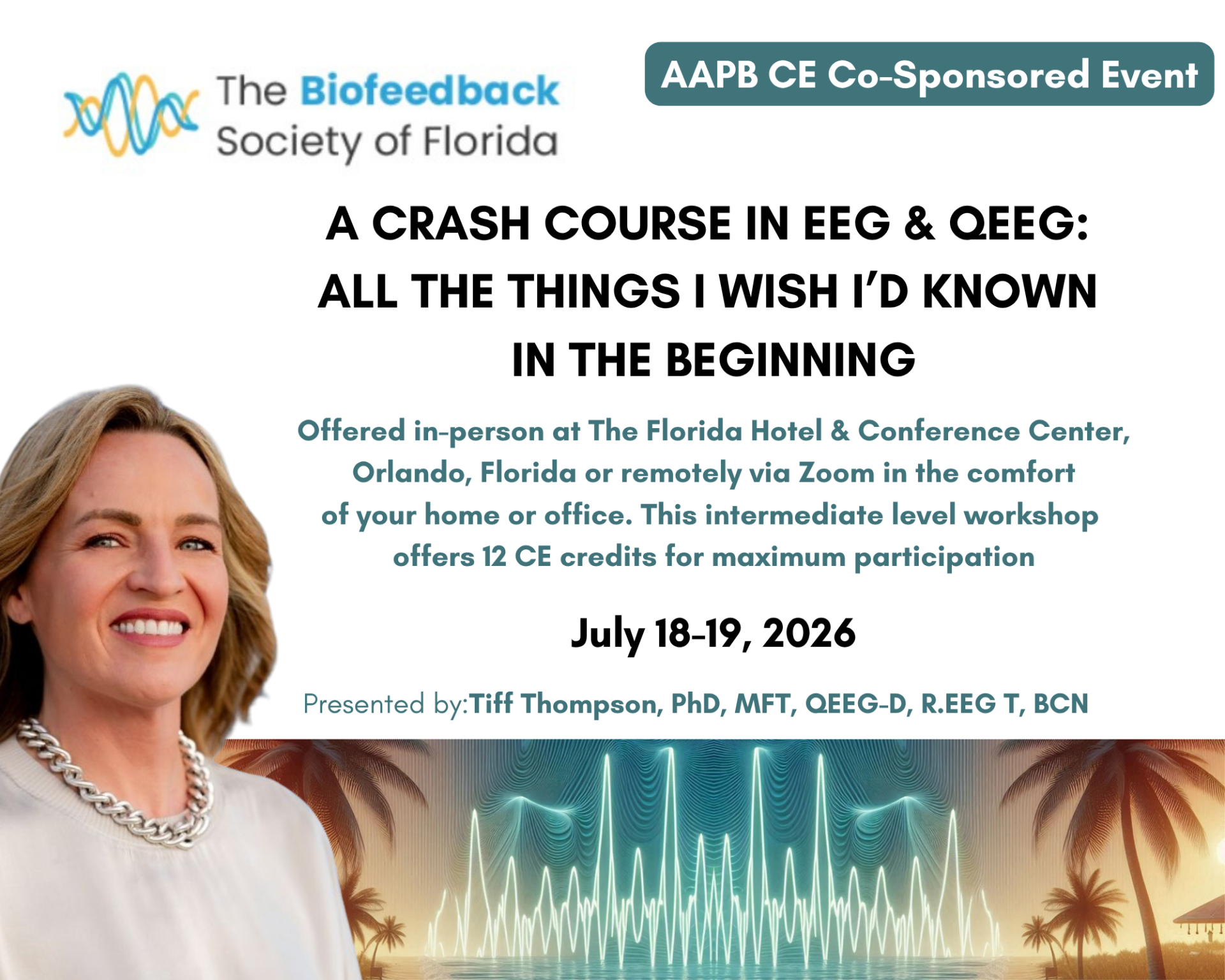
Join us for this comprehensive and clinician-friendly introduction to EEG and Quantitative EEG (QEEG) covering the practical foundations, interpretive frameworks, and clinical profiling skills that experienced practitioners wish they’d had from the start....
A CRASH COURSE IN EEG & QEEG: ALL THE THINGS I WISH I’D KNOWN IN THE BEGINNING
The Biofeedback Society of Florida is excited to announce its July 18-19, 2026 in-person and virtual CE workshop, A Crash Course in EEG and QEEG: All the Things I Wish I'd Known in the Beginning, presented by renowned neuroscientist and educator, Tiff Thompson, PhD, R.EEG.T., QEEG-DL, BCN, LMFT.
This 12 CE credit two-day intensive workshop offers a comprehensive and clinician-friendly introduction to EEG and Quantitative EEG (QEEG) — covering the practical foundations, interpretive frameworks, and clinical profiling skills that experienced practitioners wish they'd had from the start. Designed to be accessible to those new to QEEG while enriching for practitioners with existing experience, this course builds from hands-on EEG basics through disordered neurophysiological profiling, giving attendees immediately applicable clinical knowledge.
DOWNLOAD THE WORKSHOP BROCHURE HERE
Please join us in-person at the Florida Hotel & Conference Center, 1500 Sand Lake Road, Orlando, FL 32809, or live online for this exceptional program and great networking with colleagues that BSF meetings are known for. More information about the workshop, registration, and lodging follows below, and can also be found on the BSF website. We look forward to seeing you in Orlando!
EVENT CONTACT: [email protected] or by phone at 561-742-7122
REGISTER HERE: https://pci.jotform.com/form/241556458326159
DATES: July 18-19, 2026
SCHEDULE OF EVENTS:
Program Schedule - Saturday, July 18, 2026
7:30 - 8:00 - Onsite and remote sign-in, coffee/tea, announcements
8:00 - 8:30 - Tiff Thompson, PhD, R.EEG.T., QEEG-DL Introductions - attendees, instructor, and the day’s road map. Participants share their backgrounds and learning goals, and expectations are set for the two-day course arc.
8:30 - 9:30 - Gathering EEG: Recording and Processing A practical walkthrough of electrode placement, cap application, impedance checking, data acquisition protocols--the basics of signal processing and the fundamental steps before meaningful interpretation can begin.
9:30 - 10:30 - EEG for Beginners & QEEG 101 An accessible introduction to reading raw EEG waveforms, understanding what quantitative EEG adds to the clinical picture. Covers the major frequency bands, power spectral analysis, absolute vs. relative power, and the significant role of QEEG normative databases.
10:30 - 10:45 - Break
10:45 - 12:00 - History of EEG and QEEG Hans Berger’s first recordings in the 1920s, the development of computerized QEEG, normative databases, modern brain mapping. Understanding the origins of the field, its controversies and milestones — critical context for evaluating clinical tools and interpreting research.
12:00 - 1:00 – Lunch break On your own in the Florida Hotel or in the attached Florida Mall
1:00 - 2:00 – Artifacts The art of distinguishing brain signal from noise. Participants will learn to identify and manage the most common EEG contaminants — muscle artifact, movement, electrode pop, eye blinks, cardiac interference, sweat, and line noise — and understand how undetected artifacts corrupt clinical interpretation and protocol selection.
2:00 - 3:00 - Montages and Morphology Referential, linked, common average, and Laplacian montages--how montage choice shapes what you see. Morphological features of the EEG--waveform shape, amplitude, frequency, topographic distribution, and reactivity--normal and clinical presentations
3:00-3:15 - Break
3:15–4:15 - Normal Adult and Pediatric Data The healthy brain across the lifespan: developmental EEG norms from childhood through late adulthood--the reference library needed to recognize typical limits--how development, aging shape amplitude, frequency, coherence
4:15–5:15 - Vigilance and Sleep Arousal state as a modulator of the EEG – understanding its important role. The EEG continuum: hypervigilance through drowsiness, sleep stages; how state misidentification leads to misinterpretation, how vigilance-informed protocol selection improves outcomes.
Program Schedule - Sunday, July 19, 2026
8:00–10:00 - Disordered Profiling - Audience’s Choice Day 2 is a focused half-day dedicated entirely to clinical application and disordered brain profiling, drawing on the foundational knowledge built on Day 1. Participants select the clinical presentations they most need to understand. Each condition is systematically unpacked through its characteristic EEG and QEEG signatures, supported by real case examples that translate neurophysiological profiles into clinical reasoning and treatment planning. Topics available for audience selection: Anxiety · ADHD · Learning Disabilities · Autism Spectrum Disorder (ASD) · PTSD · OCD · Depression · Panic / Aggression / Rage · Head Injury & Concussion · Chronic Pain · Dementia & Age-Related Cognitive Decline.
10:00 – 10:15 – Break
10:15 – 12:30 - Disordered Profiling - Audience’s Choice (continued) Summary, Q&A, Adjourn
LOCATION:
- IN-PERSON PARTICIPATION:
The Florida Hotel & Conference Center -1500 Sand Lake Road, Orlando, FL 32809
Our meeting venue, The Florida Hotel & Conference Center still has rooms available. To make a reservation contact the hotel at (407) 859-1500 or email at [email protected]. Be sure to tell them you are attending the Biofeedback Society of Florida meeting and ask for their best rate.
- VIRTUAL LIVE PARTICIPATION: Zoom Meeting
COURSE DESCRIPTION: This two-day intensive workshop offers a comprehensive and clinician-friendly introduction to EEG and Quantitative EEG (QEEG) — covering the practical foundations, interpretive frameworks, and clinical profiling skills that experienced practitioners wish they’d had from the start. Designed to be accessible to those new to QEEG while enriching for practitioners with existing experience, this course builds from hands-on EEG basics through disordered neurophysiological profiling, giving attendees immediately applicable clinical knowledge.
LEARNING OBJECTIVES:
- Describe the history and scientific foundations of EEG and quantitative EEG (QEEG)
- Demonstrate correct EEG acquisition procedures including electrode placement and impedance standards
- Identify normal EEG morphology and developmental norms across the lifespan
- Recognize and differentiate common EEG artifacts
- Interpret EEG frequency band activity
- Apply montage selection to clinical interpretation
- Distinguish arousal and vigilance-related EEG changes and apply them to clinical interpretation
LEVEL: INTERMEDIATE: Content builds upon the learner’s foundational knowledge, familiarity with the literature and/or experience in a content area. Programming at this level includes more depth than at a beginning level program. It could also serve as a refresher course for individuals who have a background in a content area and are interested in learning more contemporary applications.
For those psychologists using the modality of biofeedback and interested in efficacy, science, and latest clinical applications. This conference (1) presents research relevant to psychological practice, education, and science; (2) it is our intention to host a continuing educational offering to help psychologists to keep up with the most current scientific evidence regarding assessment, intervention, and education; and (3) we believe that this program would allow psychologists, or other healthcare and mental healthcare practitioners, to increase competencies in order to improve services to patients/clients. This conference is IN NO WAY a substitute
CE CREDITS FOR MAXIMUM ATTENDANCE: 12.0 MAX CE Credits
ABOUT THE PRESENTER: Dr. Tiff Thompson, PhD, MFT, QEEG-D, R.EEG T, BCN - CEO, School of Neurotherapy
Tiff Thompson, PhD, MFT, QEEG-D, R.EEG T, BCN, is a clinical neuroscientist, Licensed Marriage and Family Therapist (LMFT 89425), educator, and technologist. She is the CEO of NeuroField Neurotherapy, Inc. and the School of Neurotherapy, Inc. based in Santa Barbara, California. BCIA Board Certified in Neurotherapy (BCN), Licensed Diplomate in Quantitative Electroencephalography (QEEGDL), and a Registered EEG Technician (R.EEG.T.), her work bridges clinical practice, education, and emerging technology. Dr. Thompson has trained clinicians worldwide in QEEG analysis, neurofeedback, and Neurostimulation, with a particular focus on translating advances in computational neuroscience into accessible tools for working clinicians. She is a regular presenter at the Association for Applied Psychophysiology and Biofeedback (AAPB), the International Society for Neuroregulation and Research (ISNR), and regional biofeedback societies, where she teaches QEEG fundamentals, brain-mapping interpretation, and disorder-specific clinical reasoning.
Financial Interest Disclosure: Dr. Thompson owns The School of Neurotherapy. The School of Neurotherapy, hosts many related courses. The research findings presented herein are not related to any products or services currently provided by The School of Neurotherapy.
Utility/Validity/Risks: Materials that are included in this course may include interventions and modalities that are beyond the authorized practice of mental health professionals. As a licensed professional, you are responsible for reviewing the scope of practice, including activities that are defined in law as beyond the boundaries of practice in accordance with and in compliance with your profession’s standards.
Interventions discussed in this workshop are empirically supported (see references). Only minimal risks exist for EEG and QEEG methods, which will be addressed during the talk.
Continuing Education Statements
 Psychologists: The Association for Applied Psychophysiology and Biofeedback is approved by the American Psychological Association to sponsor continuing education for psychologists. The Association for Applied Psychophysiology and Biofeedback maintains responsibility for the program and its content.
This event offers a MAXIMUM of 12.0 CE credits for maximum participation.
 BCIA Recertification: Hour-for-hour attendance may be used to fulfill the continuing education requirements for recertification, with certificate(s) of attendance. The Biofeedback Certification International Alliance (BCIA) was created with the primary mission to certify individuals who meet education and training standards in biofeedback and progressively recertify those who advance their knowledge through continuing education.
 IQCB will accept 12 credits for recertification for full attendance as qEEG-specific credits.
Psychologists (APA) Coverage & Reciprocity:
The following state boards accept courses from APA providers for Counselors: AK, AL, AR, AZ, CA, CO, CT, DC, DE, FL, GA, HI, IA, ID, IL, IN, KS, KY, MD, ME, MO, NC, ND, NH, NE, NJ, NM, NV, OK*, OR, PA, RI, SC, SD, TN, TX, UT, VA, WI, WY
MI: No CE requirements
The following state boards accept courses from APA providers for MFTs: AK, AR, AZ, CA, CO, CT, DE, FL, GA, IA, ID, IN, KS, MD, ME, MO, NE, NC, NH, NJ, NM, NV, OK*, OR, PA, RI, SC, SD, TN, TX, UT, VA, WA, WI, WY
The following state boards accept courses from APA providers for Addictions Professionals: AK, AR, CO, CT, DC, DE, GA, IA, IN, KS, LA, MD, MO, MT, NC, ND, NE, NJ, NM, NY (outstate held), OK*, OR, SC, UT, WA, WI, WY
* OK accepts APA credit for live, in-person activities. For all ethics and/or online courses, an application is required.
MA / MFTs: Participants can self-submit courses not approved by the MAMFT board for review.
The following state boards accept courses from APA providers for Social Workers: AK, AR, AZ, CA, CO, DE, FL, GA, ID, IN, KY, ME, MN, MO, NE, NH, NM, OR, PA, VT, WI, WY
Other Information
AMERICANS WITH DISABILITIES ACT (ADA) STATEMENT: ADA accommodations will be made in accordance with the law. If you require ADA accommodation, please indicate what your needs are at the time of registration. We cannot ensure the availability of appropriate accommodations without prior notification.
GRIEVANCE POLICY: The Association of Applied Psychophysiology and Biofeedback (AAPB) is fully committed to conducting all activities in strict conformance with the American Psychological Association's Ethical Principles of Psychologists. AAPB will comply with all legal and ethical responsibilities to be non-discriminatory in promotional activities, program content and in the treatment of program participants. The monitoring and assessment of compliance with these standards will be the responsibility of the Education Chair in consultation with the members of the continuing education committee, the AAPB Ethics Chairperson, Continuing Education (CE) Committee Chairperson, Program Planning Committee Chairperson, and/or the Conference Chairperson. While AAPB goes to great lengths to assure fair treatment for all participants and attempts to anticipate problems, there will be occasional issues which come to the attention of the convention staff which require intervention and/or action on the part of the convention staff or an officer of AAPB. This procedural description serves as a guideline for handling such grievances. 1. When a participant, either orally or in written format, files a grievance and expects action on the complaint, the following actions will be taken. If the person toward whom the grievance is directed is also the instructor or a chair of any of the above-mentioned committees, the AAPB Board of Directors will appoint a Board representative to oversee the resolution of any of the participant complaints, in an effort to avoid any and all conflicts of interest. If the grievance concerns a speaker, the content presented by the speaker, or the style of presentation, the individual filing the grievance will be asked to put his/her comments in written format. The CE Chair will then pass on the comments to the speaker, assuring the confidentiality of the grieved individual. 2. If the grievance concerns a workshop offering, its content, level of presentation, or the facilities in which the workshop was offered, the convention chair will mediate and will be the final arbitrator. If the participant requests action, the convention chair will: a) attempt to move the participant to another workshop or b) provide a credit for a subsequent year's workshop or c) provide a partial or full refund of the workshop fee. Actions 2b and 2c will require a written note, documenting the grievance, for record keeping purposes. The note need not be signed by the grieved individual. 3. If the grievance concerns an AAPB CE program, in a specific regard, the CE Chair will attempt to arbitrate.
Contact name(s)*: Leslie Shivers, AAPB Executive Director
Email: [email protected]
Telephone: 800-477-8892 or +1 303-422-8436
Address: PO Box 461797, Aurora, CO 80046-1797
Participants are asked to be aware of the need for privacy and confidentiality throughout the program. If program content becomes stressful, participants are encouraged to process these feelings during discussion periods. If participants have special needs, we will make every attempt to accommodate them in compliance with the ADA.
Refund/Cancellation Policy: Cancellations received by the BSF office by July 10, 2026 will be refunded minus a $25 processing fee. No refunds will be granted after July 10, 2026. Cancellations must be made in writing and emailed to [email protected].
IMPORTANT NOTICE: Those who attend this conference in full and complete the appropriate sign-in and evaluation forms will receive CE credits. Those arriving more than 15 minutes after the start time or leaving before a given conference activity is completed will not receive CE credit.
